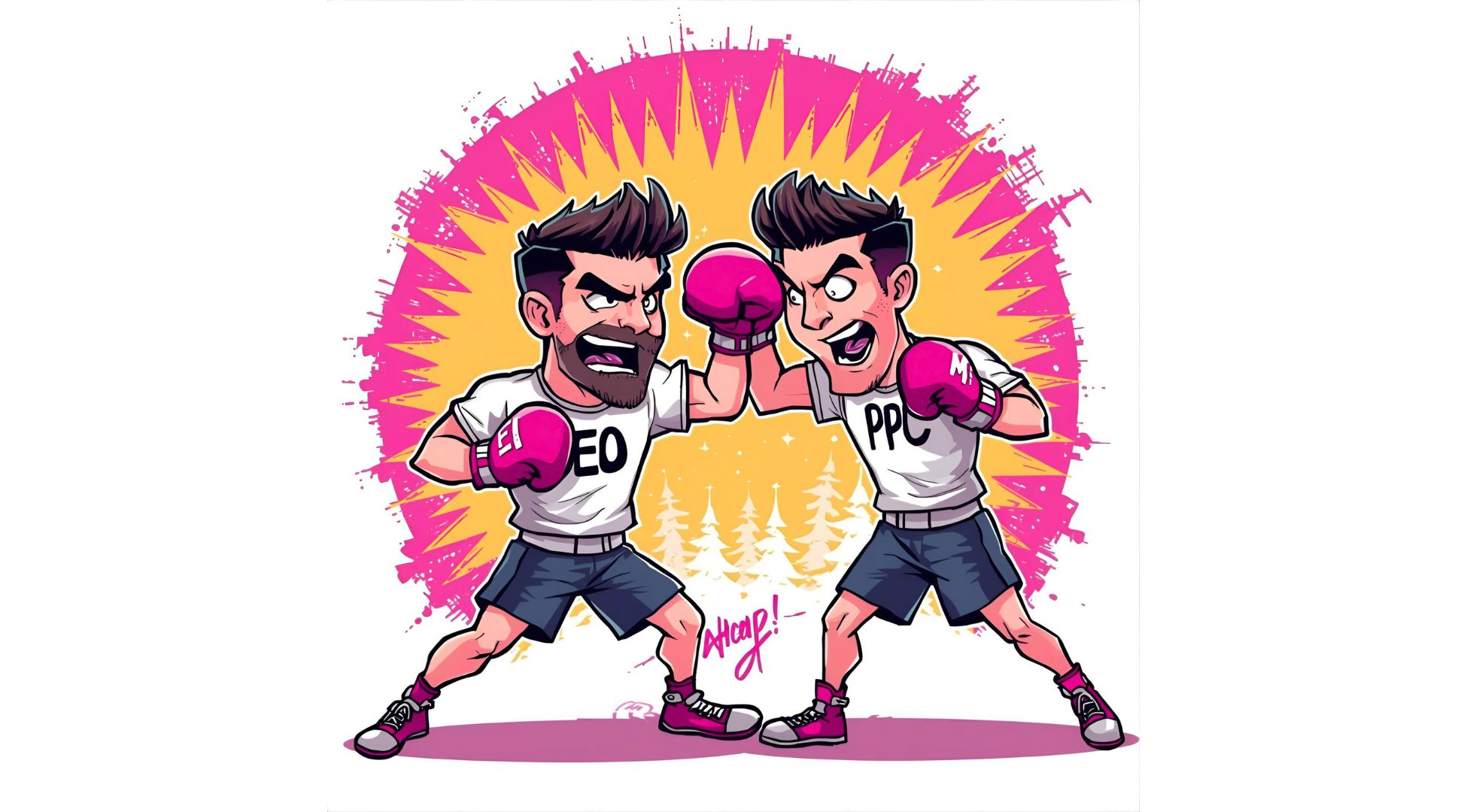
In each corner, PPC vs SEO, which is better? Find out what they are and what I think about each below…

PPC (Pay-Per-Click): Paid advertising that can place your site prominently in search results quickly, with visibility determined by factors such as your bid, budget, competition, ad quality, and relevance.
SEO (Search Engine Optimization): Improving your site and content to earn organic rankings, which takes time but builds lasting credibility and traffic.
If your goal is making the most money rather than simply getting traffic, here is the short answer:
Long term: SEO + AI Search wins.
Short term: PPC wins.
Best overall: Use PPC to bring in leads and sales now while building an SEO and AI Search presence that can keep bringing new customers to your business without paying for every click.
| SEO + AI Search | PPC | |
|---|---|---|
| Results | Slow initially | Immediate |
| Upfront cost | Higher investment in strategy, content, and optimization | Lower to start, depending on the campaign |
| Cost per additional visitor | Can become very low once established | You pay for every click |
| Long-term ROI | Potentially excellent | Usually limited by ongoing ad costs |
| Scalability | Strong once visibility and authority grow | Limited by ad costs and available demand |
| Risk | Algorithm and AI Search changes | Rising costs per click and competition |
| Best for | Building authority and a long-term asset | Generating immediate leads and sales |
Who wins the battle?
Many businesses question whether SEO is still worth the investment or whether they should put that budget into PPC instead. Some think SEO’s glory days are behind it because search feels oversaturated or organic results take too long. AI-powered search is giving SEO a broader role by rewarding the authority, relevance, and credibility a business builds over time. Paid ads can generate clicks quickly. That speed has value, although it does not always create lasting impact.
When I think about the difference, it reminds me of the old days of advertising. Paid spots on TV were everywhere. A brand could buy thirty seconds during prime time and get instant visibility. Viewers knew it was paid. Nobody thought you earned that airtime. Word of mouth was the opposite. It spread slowly but it stuck. When your friends told you about a new product or your coworkers vouched for a service, you listened. That was credibility. That was trust. It wasn’t bought one click at a time (although earning it still required time and effort.)
PPC is today’s version of those TV ads. It is like buying your way to the front of the line. As long as the campaign remains active and competitive, you can maintain paid visibility. When you stop funding it, that paid visibility stops too. I know that some people get hooked on that adrenaline rush. They love seeing their brand at the top of Google and the traffic pouring in. The bills always come due. Budgets shift, costs per click rise, competition increases. The clicks are only as strong as the budget behind them. Some consumers click sponsored results because they want an immediate answer. Others scroll past them in search of a business that has earned strong organic visibility. Both behaviors matter, which is one reason paid and organic search work best together.
A good argument for PPC would be attorneys looking for clients who need to hire them immediately because something like a car accident has happened. The process from start to finish and on to the next is fast-paced.
Why PPC makes sense in certain situations:
- Attorneys seeking immediate clients, such as after a car accident
- Businesses launching a new product that need instant attention
- Companies testing a new offer before investing in SEO
- Brands running retargeting campaigns to convert window shoppers
SEO, on the other hand, is the modern form of word of mouth. It is slower. It takes work and patience. You cannot flip a switch and rank number one tomorrow. When you do it right, however, the results build on themselves. I’ve watched clients put in the effort to create useful content (useful, not keyword stuffing into thousands of words), tighten up their site, and invest in long-term optimization. Months later, their organic traffic grows steadily. In my experience, clients who make that long-term investment can eventually rank across dozens of relevant searches and reduce their reliance on paid acquisition. The timeline and results vary, but the value of strong organic visibility can continue building over time. That growth feels earned, because it is.
Why SEO makes sense for long-term growth:
- Online magazines that rely on credibility and authority
- Luxury brands that need to build and maintain reputation
- Businesses focused on sustainable organic traffic
- Companies wanting lower cost per acquisition over time
That doesn’t mean PPC is useless. There are moments when it can be the right option. Launching a new product? Run ads to get attention fast. Testing a new offer? Use PPC to see how your audience responds before investing in a full SEO strategy. Even something as simple as retargeting (showing ads to people who already visited your site) can turn window shoppers into buyers. PPC is at its best when it has a clear purpose and measurable return, rather than becoming your only source of visibility.
The healthiest approach I’ve seen is when companies use PPC and SEO together.
How PPC and SEO work best together:
- Ads give you immediate data: which keywords drive clicks, what headlines pull people in, what landing pages convert
- SEO builds on that data to create sustainable growth
- Over time, the organic side carries more of the load while PPC acts as a complement instead of a crutch
The truth is PPC and SEO are not enemies. They are just different. One buys attention. The other earns it.